

Editor’s note: This story originally appeared Aug. 8, 2020, on the now-shuttered SprintCarAndMidget.com, whose coverage has since been incorporated into the SPEED SPORT platform.
PATH VALLEY, Pa. — Tyler Courtney discovered the spirit of this lifelong pursuit in the summer of 2009, a 16-year-old Indianapolis kid learning under someone he viewed as a superhero.
Courtney gave up a summer of developmental racing for the chance to work around Bryan Clauson, wanting to learn everything he could about race cars and the operation behind them. Maybe, Courtney thought, he could someday drive a little like his hero.
But he quickly learned there was more to Clauson than driving.
Working around Clauson’s race team that summer, Courtney saw how one of the sport’s superstars carried himself away from the racetrack. He learned what being a champion looked like beyond winning races.
“Seeing another side of a guy you look up to as a superhero, getting to know him on a personal level, I just wanted that,” Courtney said.
All these years later, Clauson’s spirit and the stories surrounding him live on without their source.
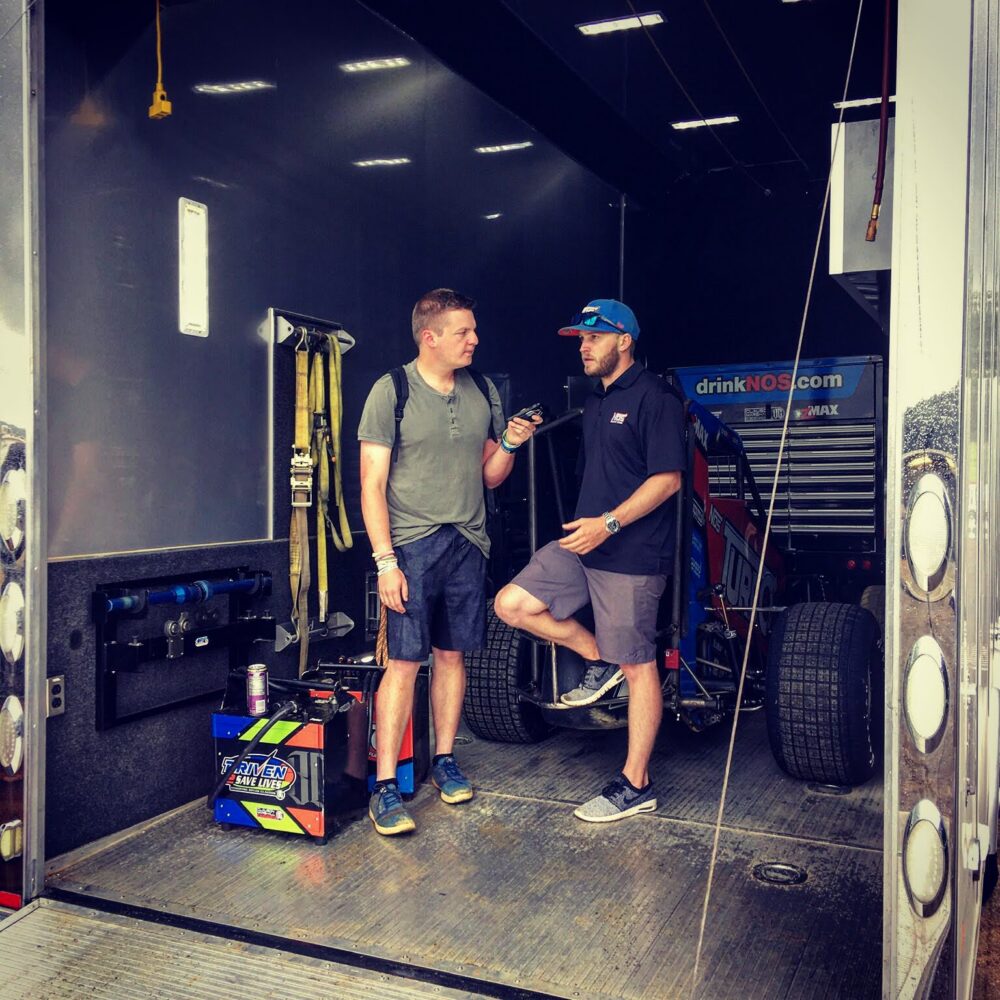
Friday marked four years since Clauson died from injuries suffered in a Midget crash at Belleville High Banks Speedway, his remarkable life and career cut short at 27. And there Courtney was, standing near the trailer housing his Clauson-Marshall Racing No. 7BC Midget and watching a somber rainfall at Path Valley Speedway, where the fourth round of USAC Eastern Midget Week was supposed to be held.
Before the rain eventually washed away the night, Courtney did what so many throughout racing have done since Aug. 7, 2016: keep Clauson’s presence alive through treasured memories.
In 2020, Courtney has established himself among Midget racing’s elite while carrying Clauson’s name. The fiercely competitive, fun-loving spirit Courtney first encountered in 2009 remains one of his guides.
“He showed you how to compose yourself on and off the racetrack,” said Courtney, the reigning USAC National Midget champion. “Getting to see that aspect those two summers was something I really think has put me in the spots I am today and learn how to deal with adversity. Everything isn’t going to be perfect, but it’s how you deal with it is how those results change.”
Perhaps no period better demonstrated Clauson’s resilience than his brief NASCAR career.
After rising through USAC’s ranks, Clauson signed a developmental deal with Chip Ganassi Racing as a teenager and competed in NASCAR’s second-tier series in 2007 and ’08, recording two top-10 finishes and a pole in 26 starts.
He was supposed to drive full-time for Ganassi in 2009, but those plans disappeared when the team merged with Dale Earnhardt Inc. and its Nationwide Series program folded. The development abruptly ended Clauson’s stock car path and ultimately sent him back to his dirt-track roots.
Clauson didn’t wither. Instead, it became the beginning of the career that cemented his place in short-track racing lore. Levi Jones, the former USAC standout who now serves as the series executive vice president, had a front-row seat.
“To be mentally strong enough and focused, to have your NASCAR deal not work out, come back, figure out to make it work; win, be happy, make a living,” Jones said. “In this world that’s what you have to figure out what to do. He did that.”
Clauson’s list of accomplishments remains staggering: three USAC National Midget championships, three USAC National Drivers Championships, two USAC National Sprint Car titles, two Turkey Night Grand Prix victories, the 2014 Chili Bowl, three Indianapolis 500 starts, a Knoxville Nationals preliminary victory and an ARCA win among them.
“I could be here all day and list everything he did,” Courtney said. “He was one hell of a racecar driver.”
As the years pass and Aug. 7, 2016, becomes more distant, people such as Courtney and Jones have become the storytellers responsible for introducing Clauson to those who never had the opportunity to know or watch him.
Every so often, Jones’ daughter and two sons stumble across an old photograph of their father racing Clauson. Inevitably, a story follows.
“It’s fun to tell them the stories,” Jones said. “But it also really sucks because they didn’t get to see him live it. That’s the unfortunate part of life. Our memories, views and stories have to be passed down.”
Jones retired from driving in 2012 with a considerable legacy of his own, and Clauson soon followed him into the Tony Stewart Racing seat on the USAC National Sprint Car tour.
In his first season driving Jones’ former ride, Clauson won seven of 31 races on his way to the 2013 series championship. A year earlier, he had qualified for his first Indianapolis 500. As Jones transitioned from driving into roles away from the cockpit, Clauson’s range became increasingly apparent.
“I try to tell these kids, ‘He didn’t just show up and plop into that IndyCar,’” Jones said. “He was young and good and fast. He proved he could do it.”
Fittingly, two of Courtney’s and Jones’ favorite accomplishments involved beating Clauson.
Jones’ final victory came June 12, 2013, at Gas City I-69 Speedway, where he held off Clauson, Kyle Larson and Christopher Bell in a running order that looks even more remarkable years later.
“That’s probably one of the biggest wins in my career that paid $1,200 and didn’t mean s—,” Jones said. “But that’s why you raced. You wanted to beat the best.”
Courtney’s moment also came at Gas City — on July 8, 2016, just 30 days before Clauson’s eventual death — though under much different circumstances. He was still a winless youngster searching for his first USAC National Sprint Car victory.
Courtney spun on the opening lap before methodically working his way back through the field. He had climbed to second when a caution flew with seven laps remaining.
Only Clauson remained in front of him.
“I’m like, ‘It’s Bryan Clauson, you’re not going to beat Bryan Clauson,’ ” Courtney remembered thinking.
Courtney committed to the bottom while Clauson stayed on the top. Eventually, the student found his way past the mentor.
Courtney went on to win his first USAC National Sprint Car race.
“Here I am, a 20, 21-year-old kid who won his first USAC National Sprint Car race and beat my idol,” Courtney said.
In victory lane, Courtney anticipated some kind of embrace or congratulatory moment from his mentor. It never came.
Clauson hated losing.
The next day at Kokomo Speedway, though, Courtney got what he had been waiting for.
“Sorry, I was in a bad mood last night, buddy,” Clauson told him as Courtney recalled. “I’m super proud.”
“That, right there, meant more to me than winning the race,” Courtney said. “I spent those two summers looking up to him. A lot of things I learned to win that race was from him.”
Winning was always the expectation with Clauson, no matter the setting.
Courtney still remembers a 2010 trip to the Belleville Midget Nationals and a Wednesday night visit to a local Dave & Buster’s. Clauson had been on a roll, so his father, Tim, made a deal with his son and the team: Win all six races that week, and they’d buy a horse-racing arcade machine like the one at Dave & Buster’s.
Clauson finished third on opening night.
He was crushed.
“It didn’t matter if it was cornhole, or pop-a-shot, or racing horses at Dave & Buster’s, he was the most competitive person ever,” Courtney said.
Clauson still went on to win the Belleville Midget Nationals championship that week, staying true to the competitive nature that defined him.
In some ways, Courtney has followed a similar path.
He has expanded his pursuits into winged Sprint Cars, something Clauson increasingly did toward the end of his career. Courtney has developed his own personality and brand, too, though even that carries a connection to Clauson.
Most know Courtney as “Sunshine,” a nickname Clauson gave him because of Courtney’s resemblance in looks and personality to the character Sunshine from the movie “Remember the Titans.”
“Bryan was a superhero in those comic books: they never die, they’re always alive,” Courtney said. “When a guy like that passes away, it brings things back to reality that anything can happen to anybody.”
Days like Friday reinforced that reality.
As Courtney watched the rain fall at Path Valley four years after Clauson’s death, another memory became difficult to ignore.
“Every year on this day it seems like it rains,” Courtney said. “I think it’s his way of saying, ‘Hey, hello, you aren’t doing this without me.’
“At least not today.”


